Introduction
Can you solder a flexible printed circuit the same way as a rigid board? Not quite. Heat, movement, and joint stress affect a flexible printed circuit, or FPC, very differently. In this article, you will learn how to prepare an FPC, solder it correctly, choose the right method, and avoid common failure points.
Prepare the Flexible Printed Circuit (FPC) Before Soldering
Understand what makes FPC soldering more sensitive
A flexible printed circuit behaves differently from a rigid board as soon as heat is applied. Its substrate is thinner, easier to deform, and more likely to shift during handling, while the bonding system beneath the copper can soften if temperature or dwell time is too high. That means the margin for error is smaller from the start.
At the same time, the solder joint itself stays rigid even though the flexible printed circuit can bend. This mismatch is one of the biggest reliability concerns in FPC assembly. If stress is not controlled, bending force moves into the pad edge, copper trace, or component lead instead of being absorbed by the circuit body. For that reason, a good solder joint on an FPC is not only about electrical contact. It is also about protecting the joint from later mechanical strain.
Dry, clean, and secure the board before any heat is applied
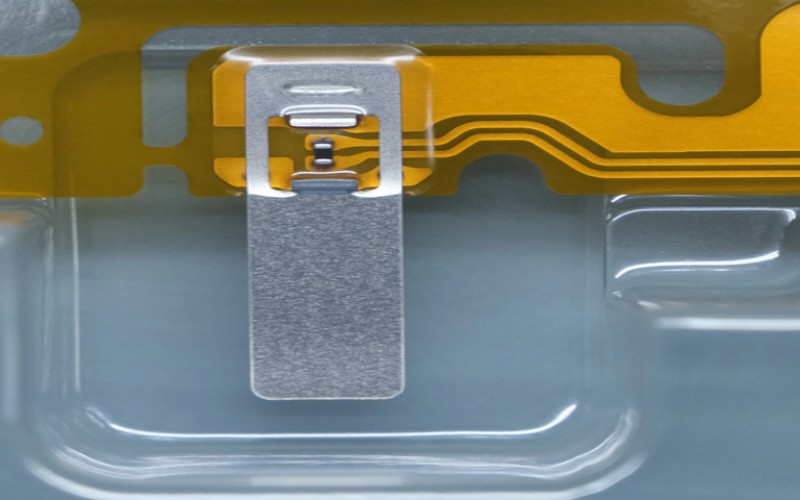
Before soldering, moisture and movement should be treated as real process risks. A flexible printed circuit can absorb moisture more easily than a rigid board, and trapped moisture can raise the chance of blistering or delamination once heat is introduced. Drying the board when needed helps reduce that risk, especially if the material has been stored in humid conditions.
Surface condition matters just as much. Pads should be clean enough for good wetting, and the work area should be stable enough to stop the FPC from shifting or curling during contact with the iron. If the board moves while heat is applied, alignment can drift and pads can be damaged. In practice, securing the flexible printed circuit to a stable surface is one of the easiest ways to improve soldering quality.
● Check for moisture exposure before soldering
● Clean pads and contact areas before fluxing
● Fix the FPC to a stable surface to prevent movement
Gather the right tools for controlled, low-stress soldering
The best tools for FPC work are the ones that improve control. A temperature-controlled soldering iron with a fine tip is more useful than a hotter, more aggressive tool. Suitable solder or low-residue solder paste, a flux pen, tweezers, tape, and magnification all help reduce force and improve placement accuracy.
The goal is precision rather than speed. On a flexible printed circuit, too much pressure or poor visibility can create damage before a joint even forms. A careful setup lets you use less heat, less solder, and less force, which is exactly what FPC assembly requires.
Tool | Why it matters |
Fine-tip soldering iron | Limits heat spread and improves pad access |
Flux pen | Improves wetting and solder flow |
Tweezers | Stabilizes small parts during placement |
Magnification | Helps catch pad shift and bridging early |
How to Solder Flexible Printed Circuit by Hand
Align and tack components before finishing the joint
Hand soldering an FPC starts with controlling movement before controlling heat. Place the flexible printed circuit on a stable surface, line up the component carefully with tweezers or tape, and create one or two small tack joints first. Once the part is anchored, you can return and complete the remaining pads without fighting drift or rotation.
This method is especially useful on a flexible printed circuit because the surface can move slightly even when it looks flat. A small shift during the first joint can cause misalignment across the whole part. Tack soldering gives you a way to lock position early, which reduces rework and makes the rest of the soldering process more predictable.
● Fix the FPC so it cannot slide
● Align the component before heating
● Tack opposite points first
● Finish the remaining joints only after the part is stable
Use minimal heat, pressure, and solder
The basic rule for soldering a flexible printed circuit by hand is simple: use the least thermal and mechanical load that still forms a complete joint. Long dwell time, high tip temperature, or heavy downward pressure can soften the material under the copper, reduce bond strength, or even encourage pad lifting. These problems may not look severe at first, but they can shorten the life of the assembly.
A complete joint does not require force. It requires proper heat transfer. A clean, tinned iron tip, suitable flux, and a small amount of solder help transfer heat efficiently, so you do not need to stay on the pad longer than necessary. This matters even more on an FPC because the materials are less tolerant of excess heat than rigid PCB materials.
Solder small SMT parts and connectors with extra care
Small SMT components require tighter control because the pads are small and the margin for excess solder is limited. On fine-pitch parts, too much solder can bridge adjacent contacts, while too much heat can shift the part or distort the pad area. For tiny passive components, apply only a small amount of paste or solder and bring the iron into brief contact with both the pad and the termination.
Connector areas deserve even more attention. A connector on a flexible printed circuit often sits near a transition point that later sees insertion force, cable pull, or repeated handling. That makes connector zones both electrical and mechanical risk points. They usually need better support and cleaner solder volume control than larger, low-stress components mounted elsewhere on the FPC.
Hand-solder focus area | What to watch closely |
Fine-pitch IC pads | Bridging and part shift |
Small resistors and capacitors | Excess solder volume and uneven heating |
Connector terminations | Strain concentration and alignment |
Pad edges | Early signs of lifting or distortion |
Inspect and clean immediately after soldering
Inspection should happen right after soldering, not later as a separate task. First, check joint shape under magnification and confirm that the solder has wetted both the pad and the component termination. Then test continuity and look for shorts before the flexible printed circuit moves to the next assembly step.
Cleaning also belongs in this stage. If residue remains, remove it with an appropriate cleaner unless the process is truly designed around no-clean materials. On an FPC, residue can hide defects in small pad areas and make later checks less reliable. Inspection and cleaning are part of soldering quality, not an optional finishing step.
Choosing the Right Soldering Method for FPC Assembly
When hand soldering is the best option
Hand soldering is often the best choice when process flexibility matters more than production speed. It works well for prototypes, repairs, engineering samples, and low-volume builds where the operator may need to make placement adjustments or handle unusual layouts. On a flexible printed circuit, that extra control can be valuable because some assemblies need careful local support instead of a fully automated flow.
Still, hand soldering has limits. It depends heavily on operator skill, so solder volume, heat exposure, and joint shape are harder to keep identical across multiple units. It is also less suitable for very fine-pitch assemblies where repeatability matters more than individual adjustment.
When reflow soldering is better for flexible printed circuit assembly
Reflow soldering is usually the better method for surface-mount FPC assembly when consistency is the main goal. Once solder paste printing, component placement, and the heating profile are controlled, reflow produces more uniform joints across many pads at once. That makes it a strong choice for repeatable production and dense SMT layouts.
Even so, the process cannot simply copy rigid board settings. A flexible printed circuit needs an appropriate thermal profile and careful process control to avoid overstressing the substrate, bonding layers, or component package. Reflow can improve consistency, but only if the FPC is heated in a controlled and well-supported way.
Why fixturing and carriers are often necessary for FPC
Unlike rigid boards, an FPC does not naturally stay flat during placement, transport, or heating. That is why carriers and fixtures are often essential rather than optional. A rigid support lets the flexible printed circuit move through solder paste printing, part placement, and thermal cycles without curling, shifting, or sagging.
Good fixturing also improves alignment accuracy and reduces handling damage in delicate areas. In other words, fixtures do not only support the board physically. They also support process stability.
Assembly method | Main support need |
Hand soldering | Local stabilization during joint formation |
Reflow assembly | Full-panel support through placement and heating |
Wave-type processes | Rigid backing with exposed solder areas |
Common FPC Soldering Mistakes and How to Avoid Them
Placing joints too close to bend areas
One of the most common flexible printed circuit mistakes happens before soldering even starts: placing pads, vias, or component terminations too close to a bend path. A flexible printed circuit can tolerate motion, but a solder joint cannot. When the assembly bends repeatedly, the rigid joint becomes a stress concentrator, and the strain moves into the pad edge, copper trace, or lead interface.
This is how ordinary motion turns into fatigue. A layout may look acceptable in a static prototype, but repeated folding, twisting, or dynamic flexing can make the joint fail much earlier than expected. The safer approach is to keep soldered regions away from repeated bend points, folds, and transitions whenever possible.
Overheating the flexible printed circuit
Heat damage on an FPC is often subtle at first. Too much temperature or too much dwell time can soften the material under the copper, weaken the bond, and lead to pad movement, delamination, blistering, or lifted features. Pressing with the iron while the material is softened only makes the risk worse.
The best way to avoid this is to use only the minimum effective heat. A clean tip, correct flux, and efficient contact time are usually better solutions than increasing temperature or pushing harder. On a flexible printed circuit, low-stress process control protects both the substrate and the joint.
Mistake | Likely failure mode |
Joint placed in a bend path | Fatigue cracking over time |
Excessive heat or dwell | Blistering, delamination, or pad lift |
Pressure on a softened pad | Pad shift or weakened adhesion |
Joint over a support transition | Localized stress and early failure |
Leaving solder joints unsupported in high-stress areas
Even a visually good joint can fail if it sits in the wrong mechanical location. Areas near connector edges, stiffener terminations, and unsupported spans carry higher local stress because the flexible printed circuit follows surface changes and transfers load into those boundaries. In many cases, these failures are blamed on poor soldering even though the root cause is mechanical layout.
Support features such as backside reinforcement or local stiffening can reduce movement where it matters most, especially near connectors and heavier components. The key is to stop the soldered region from becoming the hinge point of the assembly. If that happens, every insertion cycle, cable pull, or flex event shortens joint life.
Improve Long-Term Reliability After Soldering
Keep bending stress away from soldered areas
Long-term reliability depends on one simple rule: the circuit may flex, but the solder joint should not be the feature absorbing repeated motion. Once a joint sits inside a bend path, the rigid solder mass transfers strain into the pad edge, copper trace, or component termination. That is why routing, pad placement, and component location still matter even after soldering is complete.
If the design allows movement, direct that movement into the intended flex sections rather than into connector pins, component pads, or transition points. A flexible printed circuit can work well under motion, but only if the soldered regions are protected from becoming fatigue points.
Add reinforcement where movement cannot be avoided
Some assemblies must bend in service, so the goal is not to make the whole FPC rigid. The better approach is selective reinforcement. Local stiffeners, backing films, strain-relief features, and carefully placed support layers can reduce motion where soldered areas are most vulnerable, especially near connectors, sensors, or heavier parts.
Reinforcement works best when it spreads stress gradually. If it creates a sharp transition, the failure point may simply move to the edge of the reinforced zone. That is why support should protect the joint area while still allowing designed flex in the surrounding circuit.
Reinforcement option | Best use |
Local stiffener | Protects joints near components |
Backing support | Reduces pad movement during handling |
Strain relief at connector area | Lowers pull and insertion stress |
Selective potting or edge support | Limits flex directly at critical joints |
Use a final reliability checklist before the FPC goes into service
A final check separates a working prototype from a dependable assembly. Start by verifying alignment so each component fully lands on its intended pads. Then inspect wetting quality, because a joint may look acceptable from one angle while still having incomplete bonding at the pad edge.
Cleanliness also matters. Residue can hide defects or create later reliability problems in tightly spaced areas. Electrical continuity should be verified before the flexible printed circuit is bent, installed, or connected to the next subsystem. Finally, confirm that the soldered area has enough mechanical support and will not become the hinge point of the assembly in real use.
● Verify component alignment under magnification
● Check joint wetting and pad coverage
● Remove residue if the process requires cleaning
● Test continuity and screen for shorts
● Confirm reinforcement and strain control near critical joints
Conclusion
Reliable flexible printed circuit soldering depends on careful prep, controlled heat, stable handling, and good strain protection after soldering. Whether you build one FPC by hand or scale production, strong results come from both technique and support. HECTACH delivers value with quality flexible printed circuit and FPC solutions, along with practical service that helps customers achieve safer, longer-lasting assemblies.
FAQ
Q: How do you solder a flexible printed circuit (FPC) without damage?
A: Secure the flexible printed circuit (FPC), use low heat, short dwell time, and minimal pressure.
Q: Why does a flexible printed circuit (FPC) need support during soldering?
A: A flexible printed circuit (FPC) can shift or curl, so support improves alignment and reduces pad stress.
Q: Is hand soldering or reflow better for small FPC assemblies?
A: For prototypes, flexible printed circuit (FPC) hand soldering works; for repeatability, reflow is usually better.


