Flexible devices need circuits that can bend without breaking, and that is why flexible printed circuit boards, or FPCs, matter so much today. In this article, you will learn how to make flexible printed circuit boards, when to choose DIY or professional fabrication, and how to avoid common design and manufacturing mistakes.
Choose the Right Build Method Before You Start
Define how the board will flex in real use
Before drawing traces or comparing fabrication options, define how the board is expected to move in service. A flexible printed circuit that bends only once during installation can tolerate a simpler structure than one that flexes repeatedly during operation. Static applications usually allow a more relaxed design window, while dynamic use demands tighter control over copper routing, total thickness, and bend radius. That decision also influences how conservative you must be with material selection, because repeated movement increases the risk of trace fatigue, via failure, and stress around soldered areas.
Flex scenario | Best fit | Key design priority |
One-time bend during assembly | Simple FPC interconnects | Basic bend allowance and fit |
Repeated bending in use | Wearables, moving modules, printers | Fatigue resistance and trace reliability |
Tight packaging with fixed shape | Compact electronics | Space planning and connector access |
Decide between a DIY prototype and professional fabrication
A DIY build makes sense when the goal is fast validation rather than production-grade reliability. If you are testing a single-layer idea, checking connector spacing, or proving that a folded layout fits inside a product, a home-made flexible printed circuit can be practical. Simple material stacks, manual pattern transfer, and chemical etching are often enough for early experiments.
Professional fabrication becomes the smarter path when the design includes finer features or stricter reliability targets. Use a manufacturing partner if the board needs plated vias, multilayer construction, accurate coverlay registration, or stable performance under thermal and mechanical stress. Factory processes also matter when the design must support connector insertion, repeated flexing, or tighter dimensional control than hand-built methods can usually deliver.
Set the design goal around the final application
The most useful starting point is not the circuit diagram alone, but the way the finished FPC will sit inside the product. Plan around the areas that must stay stable, the sections that are allowed to bend, and the places where parts or connectors will add mechanical load.
Key questions to lock down early:
● Where will the bend zone begin and end?
● Which regions need stiffeners or extra support?
● Will components sit near a moving section?
● How much insertion and routing space is available around connectors?
When those answers are clear, the manufacturing route becomes easier to define, and the layout is less likely to require redesign later.
How to Make a Flexible Printed Circuit Board Step by Step
Start with a bend-friendly circuit layout
The first step in making a flexible printed circuit board is not choosing chemicals or materials, but creating a layout that is meant to bend. An FPC should never be routed like a standard rigid board, because the copper pattern will also experience mechanical stress once the circuit is folded, installed, or moved in service. That is why the layout phase should define bend zones early, separate them from component areas, and keep the mechanical purpose of each section visible throughout the design.
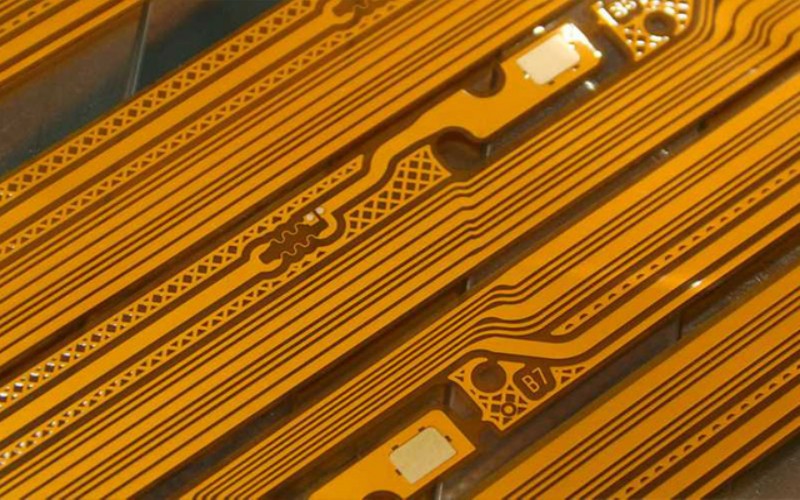
In practical terms, traces should follow smooth paths instead of sharp angular turns. Curved routing reduces stress concentration, while gradual changes in trace width help the copper transition more evenly through moving areas. Pads, holes, and exposed copper features also need careful placement, especially near sections that will bend. If a connector, solder joint, or support feature is required, that area should be treated as mechanically different from the free-flexing region rather than forced into the same layout logic.
Select the base materials and copper structure
Once the layout logic is clear, the next step is choosing the construction of the board itself. Most flexible printed circuit designs are built on a thin polymer substrate, commonly polyimide, with copper laminated onto one or both sides. On top of that conductive layer, the board usually needs a protective cover material to shield traces while preserving flexibility. Some designs also include localized reinforcement in areas where the board must stay flat or support a connector, switch, or soldered part.
Build element | Function in the FPC | Main trade-off |
Flexible substrate | Provides bendability and thermal stability | Thinner material flexes better but is harder to handle |
Copper layer | Forms the conductive traces | Heavier copper improves robustness but reduces flexibility |
Protective cover layer | Shields traces from damage and contamination | Adds durability with some effect on bend behavior |
Stiffener | Supports connectors or assembly zones | Improves stability but creates non-flexing regions |
Thinner constructions generally bend more easily, which is useful in compact products and moving assemblies. At the same time, very thin materials can feel fragile during handling, drilling, trimming, and soldering. That balance matters, because a board that is flexible on paper may become difficult to build consistently if the material stack is too delicate for the intended process.
Transfer the circuit pattern and etch the copper
After the material stack is prepared, the circuit image has to be transferred onto the copper so the unwanted metal can be removed. At a practical level, this stage follows a simple sequence: prepare the pattern, place or transfer a resist image onto the copper, etch away the exposed copper, then clean the remaining surface. The exact method depends on whether the board is being prototyped at home or fabricated with industrial tooling, but the process logic stays the same.
For a simple prototype, the goal is to create a clear resist pattern that protects the traces you want to keep. The board then goes into an etching solution until the unprotected copper dissolves. Good results depend less on complexity and more on cleanliness, alignment, and patience. If the transfer is uneven or the copper surface is contaminated, the final pattern can lose edge quality or leave weak points in narrow areas. After etching, the remaining resist and residue should be removed carefully so the copper pattern is fully exposed and ready for the next stage.
A practical process flow often looks like this:
● Prepare the substrate and copper-backed material
● Apply or transfer the circuit image
● Etch away unwanted copper
● Rinse and clean the board surface
● Inspect the trace pattern before protective finishing
Add cover protection, support, and final shaping
Once the copper pattern is complete, the FPC still needs protection and mechanical preparation before assembly. Flexible circuits typically use a cover layer instead of relying on the same surface treatment approach common on rigid boards. This protective layer helps shield traces from abrasion, moisture, and handling damage while keeping the circuit bendable. Areas intended for soldering or electrical contact remain exposed, while the rest of the conductive pattern stays protected.
Some sections also need stiffeners. These are added where connectors will be inserted, where components may stress the copper during assembly, or where a thin flex section would otherwise deform too easily. After protection and support features are in place, the board can be trimmed to shape, cleaned again if necessary, and prepared for component assembly, connector attachment, or integration into the final product.
Flexible Printed Circuit Design Rules That Prevent Failure
Keep stress out of the bend area
The bend area is the most sensitive part of any flexible printed circuit, so it should be treated as a protected mechanical zone rather than spare layout space. When a board flexes, the copper and dielectric are repeatedly stretched and compressed. Any abrupt structural interruption in that zone can turn normal movement into a localized failure point. That is why designers should keep rigid features and discontinuities away from sections that are expected to move. Poor placement may not cause immediate failure, but it can shorten service life by creating cracks, lifted pads, broken copper, or unstable solder joints after repeated bending.
Feature to avoid in the bend area | Why it increases failure risk |
Vias and plated holes | They concentrate stress and may crack under repeated flexing |
Components and solder joints | Rigid mass transfers strain into pads and copper connections |
Cutouts, slots, and sharp internal corners | They create tear-start points in the flex material |
Dense copper transitions near moving sections | They reduce strain distribution and raise fatigue risk |
A practical way to think about bend-zone design is simple: the moving section should remain as uniform and uninterrupted as possible. The more stable the geometry, the more evenly the stress can spread through the FPC. Designers who ignore this principle often end up with boards that pass electrical testing at first but fail after installation or field use, especially in products that open, fold, vibrate, or cycle through repeated motion.
Route copper for mechanical reliability
Copper routing is not only an electrical decision in an FPC; it is also a mechanical one. Traces should follow the movement of the board in a way that minimizes concentrated strain. Rounded corners are preferred because they allow force to flow more smoothly than sharp turns. Gradual width transitions also matter, since abrupt changes can produce weak spots where stress gathers during bending. In the same way, routing should respect the bend direction instead of fighting it. A trace pattern that looks acceptable on a rigid board can become fragile once flexing begins.
Useful routing habits include:
● Use arcs or soft curves instead of right-angle corners
● Taper trace-width changes rather than stepping abruptly
● Keep conductor paths consistent through the bend region
● Add teardrops where traces meet pads or holes to reduce stress concentration
These details may seem minor during layout, but together they make the copper pattern far more tolerant of motion. Reinforcement features such as teardrops are especially valuable around transition points, where geometry changes naturally increase stress. Good routing does not eliminate mechanical load, but it helps the load distribute more evenly across the circuit.
Balance thickness, bend radius, and durability
Many designers assume flexibility is only about making the board thinner, but that is only part of the equation. Real bend performance depends on the whole construction: copper weight, number of layers, adhesive system, and total stack thickness all shape how easily the board can flex and how long it can survive. A very thin flexible printed circuit may bend beautifully, yet still become unreliable if the copper is poorly routed or the bend radius is too tight for the stack. Likewise, adding layers or heavier copper can improve electrical or structural performance while reducing flexibility.
Tighter bends always demand more discipline. As the bend radius decreases, the strain on both copper and substrate rises quickly, leaving less margin for design mistakes. That is why bend requirements should be defined before the layout is finalized. When thickness, material choice, and expected motion are considered together, the board is much more likely to survive real handling, assembly, and service conditions.
What Determines Whether an FPC Is Easy to Manufacture
Prepare complete fabrication information
An FPC becomes much easier to manufacture when the design package explains not only the circuit, but also the board’s mechanical intent. A fabricator needs to know how the flexible printed circuit is built, where it is allowed to bend, and which areas must remain stable during assembly or use. If those details are missing, the supplier often has to stop and ask questions, reinterpret the design, or request file changes before production can move forward. That slows quoting, increases engineering review time, and raises the chance of avoidable revisions.
Fabrication detail | Why it must be defined clearly |
Stack-up and layer count | Determines how the board is built and processed |
Overall thickness and copper weight | Affects flexibility, handling, and manufacturability |
Stiffener locations and thickness | Tells the factory which areas need local support |
Bend regions and transition zones | Prevents the board from being treated like a standard rigid PCB |
Connector or contact requirements | Ensures the interface area is built to the right mechanical standard |
Watch the features that increase cost and complexity
In most projects, the easiest FPC to manufacture is not the most advanced one, but the one that meets the application with the fewest special demands. Extra layers, smaller features, tighter tolerances, unusual finishes, and added support structures all increase processing difficulty. Each added requirement can introduce more alignment steps, more inspection points, or more opportunities for yield loss. That is why a simpler design is often both faster and cheaper to build, especially during prototyping.
When readers compare options, they should think in terms of necessity rather than possibility. If a single-layer layout can achieve the same function as a multilayer structure, it is usually the easier manufacturing choice. The same logic applies to stiffeners, plating requirements, and ultra-tight geometry. Flex circuits reward restraint: every special feature should solve a real problem, not just reflect what the process can theoretically support.
Check the board before assembly
Before assembly begins, the board should be reviewed as a finished flex part, not just as a passed fabrication order. The most useful checks are practical:
● Confirm the circuit pattern is clean and fully defined
● Inspect exposed pads for shape, alignment, and surface quality
● Verify overall dimensions and cut profile
● Check that stiffened areas and bend sections are where they should be
● Run continuity testing before mounting components
Catching these issues early prevents misplaced connectors, poor soldering results, and wasted prototype builds.
Conclusion
Learning how to make flexible printed circuit boards means more than shaping copper. You need the right process, bend-safe design, and clear fabrication planning for a reliable FPC. Whether you build a prototype or prepare production files, smart choices reduce cost and failure risk. HECTACH adds value with flexible PCB solutions, dependable build quality, and practical support that helps turn compact electronic ideas into usable products.
FAQ
Q: What is a flexible printed circuit (FPC)?
A: A flexible printed circuit (FPC) is a bendable circuit built on thin polymer film instead of rigid FR-4.
Q: How do you make a flexible printed circuit (FPC)?
A: A flexible printed circuit (FPC) is made by designing bend-safe traces, laminating copper, patterning, etching, applying coverlay, and adding stiffeners if needed.
Q: When should a company choose professional fabrication over DIY?
A: Choose professional fabrication when the flexible printed circuit (FPC) needs plated vias, tight tolerances, multilayers, or repeatable production quality.


